Dependencies and costs
Leaving cloud and SaaS: plan your exit before you need it
Florian Rocktäschel · Last reviewed: November 2026 · 12 minute read
In short
An exit plan describes, on one page per critical cloud or SaaS service, which data and processes live in it, how they come out completely and in which format, which deadlines apply, who does what, and what switching costs. It only has value once it has been rehearsed. The EU Data Act helps: since 12 September 2025, customers of cloud services in the EU are entitled to a notice period of no more than two months to start switching, a transition period that normally lasts no more than 30 days, and at least 30 days to retrieve their data. From 12 January 2027, providers may no longer charge for switching. What the law secures is your data, though, not a working destination system. That part is your job.
Why plan an exit if you have no intention of leaving?
Because the trigger rarely comes from you. Typical ones:
- The price rises sharply at renewal, or the licensing model changes.
- The provider is acquired, discontinues the product or removes a feature you rely on.
- The provider runs into financial trouble or suffers a security incident.
- The legal situation changes, for instance around foreign government access to data.
- Service quality drops and support stops responding.
Services really do disappear. OpenAI announced the end of its Assistants API in August 2025 and switched it off a year later. Anyone who had built on it had to move within that year, convenient or not. I look at what this means for AI applications specifically in Switching AI models without starting over.
The strongest reason, though, is negotiating power. If you cannot leave, you do not negotiate. You renew. Providers can tell very well whether a customer has a plan B.
In financial services, this is mandatory. Since 17 January 2025, the EU’s DORA regulation has required banks, insurers and other financial entities to have exit strategies for ICT services that support critical or important functions, and those plans must be documented, tested and reviewed regularly. Most mid-sized companies are not covered. The structure is still worth borrowing, because it has been tried and tested.
Which services need an exit plan?
Not all of them. The design tool in marketing does not need one; your ERP, CRM, accounting, document management, email and single sign-on very likely do. Start with an inventory, which I call a dependency map. For each service, record:
| Question | Example answer |
|---|---|
| Which business process depends on it? | order intake, invoicing |
| Which data does it hold, and where else does that data exist? | customer master data, orders, attachments; only here |
| How long could you cope without it? | a day, a week, a month |
| Which other systems are connected? | web shop, accounting, sign-in through the provider |
| What has been customised? | custom fields, workflows, reports, scripts |
| Contract: term, notice period, next renewal | 36 months, 3 months before end of term |
| Who owns it internally, and who really knows it? | name, deputy |
Then rate each service on two questions: how bad would an outage be, and how hard would a switch be? Whatever scores high on both gets an exit plan first.
This exercise almost always turns up two things. Services IT knows nothing about, because a department pays for them by credit card. And hidden dependencies: if every employee signs in through one provider’s account, far more than email hangs on that single contract.
What should you check in a data export?
“You can export your data at any time” appears in nearly every sales pitch. What it means only becomes clear when you try. Check five things.
Completeness. An export of the customer list and orders is not a backup of your business. A complete export includes:
- master and transaction data, including archived and deleted records you are required to keep;
- attachments and documents, not just links to them;
- history and versions: who changed what, and when;
- metadata such as creation date, author and status;
- permissions and roles;
- configuration: custom fields, workflows, rules, templates, reports;
- logs you need for audits and retention obligations.
Format. Open, documented formats such as CSV, JSON, XML or a database dump with a field description are usable. A pile of PDFs is an archive, not a dataset another system can work with.
Relationships. Which order belongs to which customer, which document to which case? If the export does not carry those links, you have lots of tables and no business.
Volume and time. With large datasets, API rate limits or data egress charges slow things down. Measure once how long a full export takes. That figure belongs in the exit plan.
Restorability. An export is only verified once you have loaded it somewhere else and the numbers match: same record counts, spot checks correct, attachments open.
The Data Act is concretely useful here. The contract must contain an exhaustive list of the data and digital assets you can take with you, covering at least all exportable data. Exportable means input and output data, including metadata. Data protected by the provider’s trade secrets or intellectual property is excluded, and those exclusions must also be listed exhaustively. Ask to see both lists. Anything that is not on them, such as your workflow configuration, you need to document yourself.
What is in your contracts, and what should be?
Ask four questions before you sign anything, and read your existing contracts with them in mind now:
- In which format do we get our data back, and how quickly?
- What happens to our customisations if we switch?
- Which notice periods and minimum terms actually apply?
- What increases automatically: per-user prices, storage, support?
Then the points that matter at exit:
- Does the contract renew automatically, and by when must you give notice?
- Does the service keep running in full during the transition?
- Is exit assistance included, how much, and at what price?
- Is the data deleted afterwards, and do you get proof?
- Which subcontractors are involved, and which jurisdiction is the provider subject to?
- For custom-built software: is the source code with you or held in escrow?
Good providers answer these quickly. They know that customers who could leave are the ones who stay.
What does the EU Data Act change about switching?
Regulation (EU) 2023/2854, the Data Act, has applied since 12 September 2025. Its Chapter VI governs switching between data processing services. That means cloud services, and on a common reading everything from raw infrastructure and platforms to SaaS applications and AI services. The rules protect customers in the EU, which also matters for international groups with EU entities. Switching can also mean moving to your own infrastructure, such as servers you run or have run for you.
| Your right | What it means | Article |
|---|---|---|
| Short notice | The notice period to start switching is at most two months. | Art. 25(2)(d) |
| Transition period | Switching completes within 30 calendar days at most; the provider assists and maintains service and security. | Art. 25(2)(a) |
| Longer transition | If that is technically unfeasible, the provider must explain within 14 working days; seven months at most. You may extend the transition once. | Art. 25(4) and (5) |
| Support for your exit strategy | The provider must support your exit strategy and supply the relevant information. | Art. 25(2)(b) |
| List of data | An exhaustive list of the data and digital assets that will be ported. | Art. 25(2)(e) and (f) |
| Data retrieval | At least 30 calendar days after the transition, followed by full erasure. | Art. 25(2)(g) and (h) |
| No switching charges | From 12 January 2027, no charges for switching, including data egress; until then, direct costs at most. | Art. 29, Art. 2(36) |
| Transparency | The provider states which jurisdiction its infrastructure is subject to. | Art. 28 |
Three limits are worth knowing:
- Standard service fees and early termination penalties do not count as switching charges, although the provider must disclose them upfront. Whether a customer can switch early despite an agreed minimum term is a point on which lawyers disagree.
- Services built mostly for a single customer are exempt, as are time-limited test and evaluation versions.
- The switching rules are generally understood to apply to contracts concluded before 12 September 2025 as well. The EU’s so-called Digital Omnibus proposes exemptions for some of these older contracts, for instance with smaller providers. As of November 2026, this has not been adopted.
The most important point is not in the table. The obligation to ensure functional equivalence after switching applies only to infrastructure: servers, networks and virtual resources. With SaaS, you get your data back, not the software. Where the data goes, what it looks like there and who rebuilds the workflows is not something any law takes care of. The Data Act makes leaving faster and cheaper. Your plan is what makes it possible.
Whether and how these rules apply to your specific contract is a question for a lawyer. This article is not legal advice.
How do you test an exit without leaving?
In stages, from cheap to expensive. The first two already deliver most of the insight: 1. Tabletop exercise. Walk through the exit plan with everyone involved: who gives notice, who exports, who checks, what happens on the first day without the system? Gaps show up here already. 2. Full export. Pull everything out once and check it: record counts, spot checks, attachments, relationships. Time it. 3. Trial import. Load the export into a test environment or a candidate system. Only now do you see whether the data is worth anything without the old provider. 4. Partial move. Actually move a contained area, such as one site or one department. 5. Parallel run. Operate old and new systems side by side for a while before switching the old one off.
For most services, stages one to three are enough, once a year or before each renewal. Write down the result: duration, gaps, open points. An exit plan that has never been rehearsed is a statement of intent.
What does switching cost, and how do you calculate it?
Switching costs are almost always underestimated, because only the new licence makes it into the calculation. An honest calculation has three parts.
One-off switching costs:
| Item | What it covers | Your estimate |
|---|---|---|
| Analysis and selection | requirements, market comparison, trials | |
| Data migration | export, cleansing, field mapping, import, verification | |
| Rebuild | configuration, workflows, reports, interfaces to other systems | |
| Running both | old and new licences during the transition | |
| Contract | remaining term, early termination penalties | |
| Training and ramp-up | training, staff time, lower productivity in the first weeks | |
| Internal time | project management, business teams, IT | |
| Contingency | for whatever the trial import did not reveal |
Ongoing costs afterwards: licences or operation of the new system, maintenance, internal support, each per year.
The cost of staying: the item that is nearly always missing. What will the current service cost over the next three years if the announced or customary price increases happen? What does the risk you carry with it cost?
That gives a simple calculation:
Payback in years = one-off switching costs ÷ (annual cost of staying − annual cost afterwards)
If the result is shorter than the planned period of use, switching pays off. If it is longer, staying may be the better decision, but make it a conscious one, with the exit plan in the drawer. Cost internal days at their full rate, not at zero just because the people are already on the payroll.
An exit is cheapest when you buy it at the entrance: with a contract that settles format and deadlines, and an architecture in which your data also lives with you. What investors and buyers look for in such dependencies is covered in Technical due diligence.
From practice: exit by building your own
Besides moving to another provider, there is now a route that was hardly realistic for mid-sized companies a few years ago: building the software yourself. If you depend on an accounting system whose vendor drops a feature you need, you can say: we will do it ourselves. That is an investment, and it needs a team that can build and run software. In the long run, though, it is often the cheaper option. It comes with other duties: you have to plan operations, and you carry the security risks yourself. In return, everything is in your hands.
It is not worth it for everything. Maintainability usually decides. For a niche problem at a smaller company, rebuilding a piece of software and maintaining it for years is often not justifiable. With ERP systems I currently see how big a step it is to consider a system of your own instead of a hosted or an open source one. Still, things are moving, and fast. In October 2026 a single developer, annoyed by Adobe’s subscription model and cancellation fees, used AI to release seven free open source programs that replicate Photoshop, Illustrator, Premiere, Lightroom, Acrobat, After Effects and InDesign. They are still in alpha, and features for professional daily work are missing. But what a large team would once have built over years is now available free of charge in an early version. I expect the SaaS market to change as a result: offers will get cheaper because they have to hold their own against clones from other vendors, against open source projects and against in-house builds.
Behind this is a thought that applies to every article in this series: every company is becoming digital, not just in one small corner. A company that uses AI is an AI company and has to see itself that way. Then it needs a technology team that understands the technology and builds its own solutions where others buy. That is exactly where the market advantage lies. How to build such a team is covered in How to build a tech team that keeps going without you.
What does a one-page exit plan look like?
One page per critical service, with these fields: 1. Service and purpose: which business process depends on it, and how long an outage is tolerable. 2. Triggers: which events activate the plan (price, discontinuation, incident, legal change). 3. Data: list of data and configuration, export route, format, measured duration. 4. Contract: term, notice period, next deadline, exit assistance, deletion. 5. Destination: possible alternatives or running it yourself, with a first assessment. 6. Dependencies: connected systems, sign-in, interfaces. 7. Roles: who decides, who gives notice, who exports, who verifies, who informs staff. 8. Costs: one-off, ongoing, cost of staying, with the date of the estimate. 9. Last test: date, stage, result, open points.
Once the inventory is done, a page like this does not take long. It answers the question nobody can think through calmly in a crisis: what do we do on Monday morning?
Frequently asked questions
A cloud exit strategy sets out in advance how a company can leave a cloud or SaaS service: which data comes out in which format, which deadlines apply, who does what and what it costs. It is documented and rehearsed regularly.
On a common reading, yes. The Data Act’s switching rules apply to data processing services, which cover SaaS applications as well as infrastructure and platforms. There are exceptions, among them services built mostly for a single customer.
For switching itself, including data egress, only until 12 January 2027 and only up to its direct costs; after that, not at all. Ordinary service fees and early termination penalties are not covered by this rule.
The Data Act requires at least 30 calendar days after the end of the transition period. After that, the provider must fully erase the exportable data if the switch was successful.
The legal obligation applies mainly to financial entities under DORA. For everyone else, an exit plan is not mandatory, but it is the cheapest insurance for your most important systems and an argument in every contract negotiation.
Sources
Last reviewed November 2026. Legal information without guarantee, not legal advice.
- Regulation (EU) 2023/2854 (Data Act), in particular Articles 2, 23 to 31 and 50: EUR-Lex
- Analysis of the switching rules, scope and minimum terms (German): Noerr, May 2025
- Proposed changes under the Digital Omnibus: Greenberg Traurig, July 2026
- Exit strategies in financial services, Regulation (EU) 2022/2554 (DORA), Articles 28 and 30: EUR-Lex
- ArtCraft, AI-built open source replicas of Adobe programs (October 2026): PetaPixel, Digital Trends
- Shutdown of the Assistants API: OpenAI, Deprecations
About the author
I am Florian Rocktäschel, an engineer from RWTH Aachen. I have worked with machine learning since 2013 and as a fractional CTO for mid-sized companies since 2018. Here I write down what I am asked again and again in this work. How I help companies get out of dependencies is described on the page Vendor independence.
Where does your technology stand?
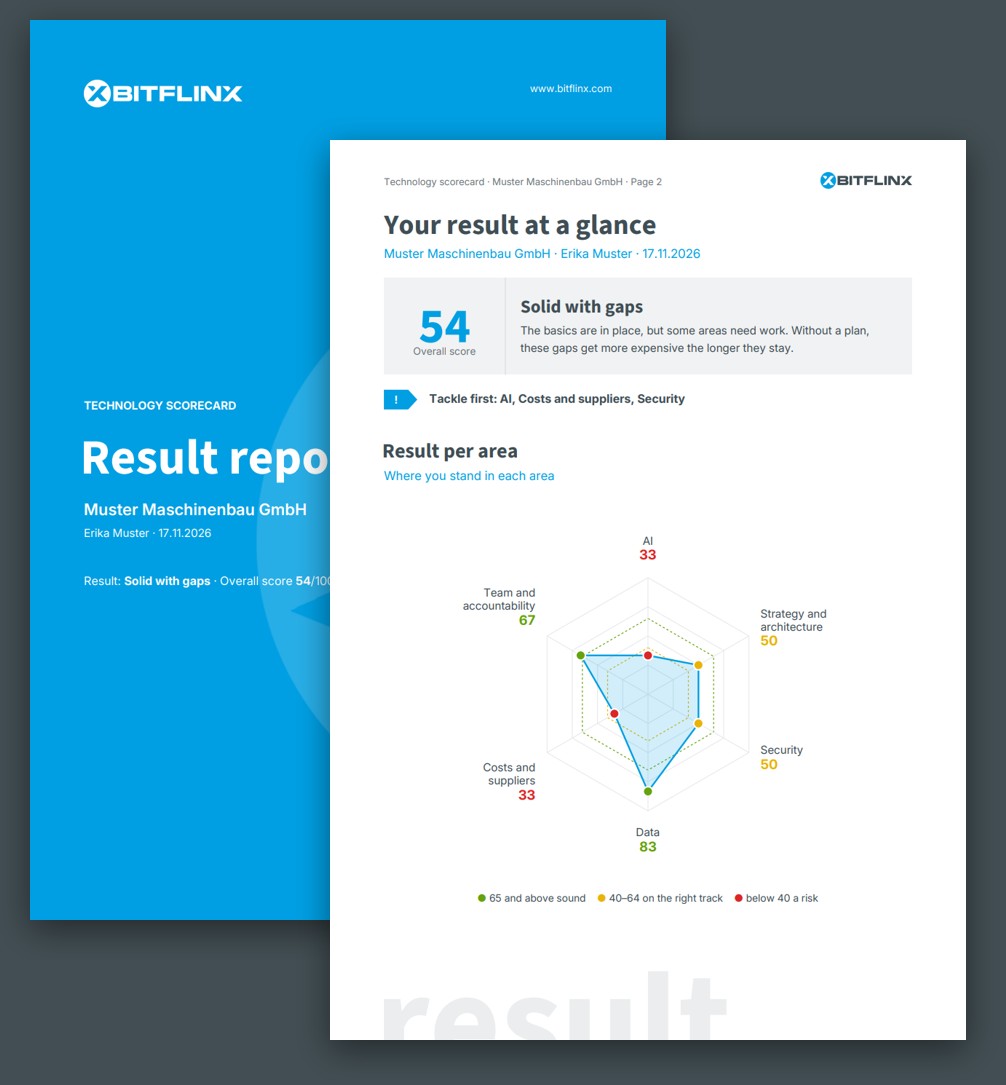
The Technology Traffic Light asks 15 questions about AI, strategy, security, data, costs and team. Ten minutes, instant result, free of charge.