IT leadership and role
Technical due diligence: what investors and buyers look at
Florian Rocktäschel · Last reviewed: November 2026 · 11 minute read
In short
In a technical due diligence, buyers or investors want three answers: does the technology support the business model, what will it cost over the next few years, and which risks belong in the price or the contract? They look at eight areas: architecture, code and engineering, security, licences and IP, team, operations, data and privacy, and the use of AI. Most findings are unpaid bills, not disasters. They become expensive when they first come to light during the review.
What is a technical due diligence?
Due diligence is the review of a company before a purchase or an investment. Alongside the financial, legal and tax review there is a technical one, and it matters more the more of the company’s value sits in software, platforms and data.
The process is usually similar. The company puts documents into a data room, the reviewers interview management and the engineering team, and the code is often analysed with tools or by a third party. The result is a report listing risks, how serious they are and what fixing them would cost.
The focus depends on the occasion. In a funding round the main question is whether technology and team can carry the planned growth. In an acquisition, legacy issues, IP and the cost of integrating into the buyer’s systems are added.
Which areas are reviewed?
| Area | Key question | Typical documents |
|---|---|---|
| Architecture | Can the system carry the planned growth, and at what cost? | Architecture overview, system list, cloud and operating costs |
| Code and engineering | Can the software be changed safely and quickly? | Repository access, test coverage, release process |
| Security | How well protected is the company against attacks and outages? | Penetration tests, vulnerability management, incident history |
| Licences and IP | Does the company own what it sells? | Software bill of materials, licence report, contracts with developers |
| Team | Does the technology keep running if key people leave? | Org chart, contracts, distribution of knowledge |
| Operations | How stable is the system, and how fast does it recover? | Monitoring, incident plan, backup tests, supplier contracts |
| Data and privacy | Is the company allowed to use its data the way it does? | Records of processing, data processing agreements, data flows |
| AI | Does the AI do what the company claims, and what does it depend on? | List of AI applications, model providers, data sources |
What do reviewers look for in architecture and code?
Architecture is rarely about elegance. An older monolith is not a defect if it is understood, tested and well run. Reviewers ask what happens at ten times the load, which parts are single points of failure, and how operating costs per customer or per transaction develop. If cloud costs grow faster than revenue, that goes straight into the valuation.
With code, what counts is how easily it can be changed. Good signs are automated tests for the core logic, a second person reviewing every change and one-click releases. If you track metrics, for example the five from the DORA research programme on lead time, deployment frequency, recovery time, change fail rate and rework, show them. Warning signs are passwords in the code, releases from a developer’s laptop and areas nobody dares to touch any more.
What is checked under security?
Reviewers want to see that security is an ongoing process. Typical questions:
- Are there recent penetration tests, and were the findings fixed?
- How quickly are known vulnerabilities in dependencies patched?
- Is access to production and data restricted, with two-factor sign-in?
- Has a restore from backup actually been tested and documented?
- Which security incidents have there been, and what changed afterwards?
Regulation comes on top. Under NIS2, management of companies in scope is personally responsible for implementing and overseeing risk management measures; in Germany this is section 38 of the BSI Act. Manufacturers of products with digital elements fall under the EU Cyber Resilience Act: its reporting obligations have applied since 11 September 2026, most other obligations from 11 December 2027, including a software bill of materials. What a buyer wants to see is that the company knows whether it is in scope and has a plan.
Why are open source licences and IP such a frequent problem?
Because almost all software today is largely made of open source, and few companies keep track of it. The vendor Black Duck analyses codebases from its audits every year, many of them from transactions. In its 2026 report, 68 percent of the 947 codebases had licence conflicts and 87 percent had at least one known vulnerability. The sample is not representative, but it shows how common the issue is. The report attributes part of the increase to AI-generated code that reproduces other people’s code without its licence.
A licence conflict usually means a component under a licence with sharing obligations (copyleft, such as GPL or AGPL) is used in a product whose source code is meant to stay closed. With the AGPL, running the software as an online service can be enough to trigger obligations. Caught early, this is rarely expensive. Found just before signing, it becomes a negotiation point.
The chain of title for your own code matters at least as much. In Germany, section 69b of the Copyright Act gives the employer the rights to software that employees write as part of their job. That does not automatically apply to contractors, agencies, or code the founders wrote before the company was incorporated. Other jurisdictions have their own rules, and the question is the same everywhere: if the contracts are missing, part of the product may not belong to the company.
There are open source tools for this. The OSS Review Toolkit generates a software bill of materials and checks licences, and OWASP Dependency-Track keeps monitoring components for new vulnerabilities.
How is the team assessed?
This is about dependence on individuals. The central question: what happens if the founder-CTO, the long-standing contractor or the agency leaves after closing? Reviewers look at the bus factor, the number of people who would have to drop out before a system can no longer be developed. The pattern is common: in a 2015 study of popular open source projects, knowledge sat with a single person in almost half of them.
Further questions: how much of the work is done by contractors, and do they work like employees? In Germany, section 7 of the Social Code IV treats working under instructions and integration into the organisation as signs of employment, with consequences for social security and back payments. How is knowledge documented? Are there retention arrangements for key people? How to build a team that passes this test is covered in How to build a tech team that keeps going without you.
What matters in operations and supplier contracts?
Reviewers want to know how stable the system is day to day: availability, monitoring, on-call, an incident plan that has been rehearsed. The contracts with hosting, cloud and SaaS providers matter just as much. Two points are often overlooked: change-of-control clauses that give a supplier the right to terminate when ownership changes, and whether, and at what cost, the company could leave a service. If you have never costed an exit, you cannot put a number on your dependency. How to plan one is covered in Leaving cloud and SaaS: plan the exit before you need it.
What do reviewers check on data and privacy?
For many business models the data is the real asset. The review asks whether the company may use it the way it does:
- Is there an up-to-date record of processing activities (Art. 30 GDPR)?
- Are there data processing agreements with every provider that handles personal data (Art. 28 GDPR)?
- Where does data flow, and on what legal basis does it leave the EU (Art. 44 ff. GDPR)?
- Where does the data used to train models or sold as analytics come from, and do consent or contracts cover that use?
Many companies rely on the EU-US Data Privacy Framework for transfers to the United States. The EU General Court upheld it in September 2025, and an appeal is pending at the Court of Justice. For a buyer this is a known risk to price in: what would it cost if that basis fell away?
What do buyers check on AI?
AI is the newest area and the one where claims and reality can be furthest apart. Reviewers ask:
- Does the AI do what the pitch deck says? Is it in the product, or is it a prototype? False claims have consequences: in 2024 the US Securities and Exchange Commission brought its first cases for so-called “AI washing” against two investment advisers.
- What does it depend on? A single model provider whose prices, terms or availability can change is a risk to the business model.
- What data goes into the models, and is that allowed?
- How much code was generated with AI, and who reviewed it? Unreviewed AI code is a source of licence conflicts and vulnerabilities. How to check such an application before launch is described in Vibe-coded app before go-live: a ten-step review.
- Regulation: does the company know which AI applications it uses and how they are classified under the EU AI Act? Since February 2025, companies have had to take care of their staff’s AI literacy (Art. 4). The AI Omnibus softened this duty in July 2026 but did not remove it.
Which findings are typical, and what follows from them?
The assessment below is my view from the technical side. What ends up in the contract is negotiated by the lawyers and the parties.
| Finding | Severity | Typical consequence |
|---|---|---|
| Copyleft component in a closed product | high if it is core functionality | Replacement before closing or an indemnity |
| Missing IP assignment from contractors or founders | high | Assignment as a condition for closing |
| Knowledge held by one person | medium to high | Retention arrangement, handover plan, price reduction |
| Outdated components with known vulnerabilities | medium | Remediation, cost reflected in the price |
| Backup never restored, incident plan never rehearsed | medium | Action in the first 100 days |
| Data transfers without a sound legal basis | medium to high | Remediation, warranty in the contract |
| Cloud costs growing faster than revenue | affects valuation | Revised business plan |
| AI feature is a prototype | affects valuation | Growth assumptions reassessed |
One pattern stands out: nearly all of this can be fixed. What makes it expensive is timing. Whatever the company discloses itself, with a plan and a cost estimate, looks like diligence. Whatever the reviewer finds looks like a hint that there is more.
How do you prepare as a seller?
Start months before the process, not when the question list arrives. A well-prepared technology data room contains:
- A one-page architecture overview and a list of all systems with owners, contracts and costs
- A software bill of materials and a licence report, with an assessment of any conflicts
- Chain of title: employment contracts, contractor and agency contracts with IP clauses, assignments from founders
- A penetration test from the last twelve months and evidence that findings were fixed
- A record of a restore from backup and the rehearsed incident plan
- Delivery and availability metrics
- An org chart and an honest list of who can change which system
- Privacy: records of processing, data processing agreements, an overview of data flows
- AI: list of applications, model providers, data sources, classification
- A list of known weaknesses with a plan and cost estimate
Some sellers commission their own technical report in advance (vendor due diligence). It pays off mainly when several bidders will be reviewing.
What should you watch for as a buyer or investor?
- Derive the scope from the investment thesis. If you buy a platform to scale it, go deeper on architecture and team. If you integrate a company into an existing group, focus on interfaces, data and contracts.
- Talk to the developers, not just management. The conversations quickly show where the knowledge lives.
- Have the code analysed, by a neutral third party if the seller will not grant direct access.
- Estimate the cost up to integration, not only the list of risks. A finding without a price does little for the negotiation.
- Use an independent reviewer. Whoever reviews should not earn from the later integration or from licences.
From practice
At an earlier company I was first CTO, then CEO. We built software for the energy sector, essentially a sales channel for installers in heating, electrical, photovoltaics and solar thermal. At some point we tried to sell parts of the company. It never happened, and the talks made clear why. We had never worked towards software that others could carry on without us, only towards finishing a product fast. What we offered was essentially a technical idea, and it was not prepared in a way that would have let someone else take it over.
What I took from it: if you want to be acquired, or if you want your software to keep some value even in an insolvency, you have to make sure beforehand that the code is accessible, properly stored and maintainable, in operations too. If a buyer comes in and finds that integrating it into their own landscape means rewriting everything, and that rules and certifications were not followed, the sale has failed before it really started.
That is why I am sceptical of quickly vibe-coded projects when a sale is the goal. In my assessment, buyers in such cases tend to buy the customers and contacts and rewrite the software afterwards. A development from this year fits: according to a Financial Times report from June 2026, the consultancy Bain uses AI to build rough replicas of target products when it reviews software companies for private equity investors. What can be rebuilt in weeks is not the value. The value lies in what cannot be rebuilt quickly: customers, operations, security, and software another team can take over.
Only what is transparent can be taken over, in development as well. Everyone must be able to understand what happens in the software, where the knowledge sits, what was done and where things can be changed. That does not mean open source; it means open by design: every component must be replaceable, ideally at the push of a button, at least with manageable effort. Otherwise the software has no value for anyone else.
What role can a fractional CTO play?
On the sell side, a fractional CTO can prepare the technology data room, fix known weaknesses beforehand or document them with a plan and cost, and translate in the conversations with the reviewers. On the buy side, they can lead the review and draw up a plan for the first 100 days after closing. Either way, responsibility for what is stated in the data room stays with the company. How I work is described on the page Fractional CTO and IT leadership.
Frequently asked questions
It depends on the scope. The review itself is usually part of a tight timeline for the whole transaction. Preparation on the sell side takes longer: chain of title, a licence report and a rehearsed incident plan cannot be produced in a few days. Plan months for it.
Not necessarily all of it. Common options are access under a non-disclosure agreement, automated scans by a neutral third party, or a look at selected parts. What is appropriate depends on the stage of the deal and on the risk if the buyer is a competitor.
Open source as such is not; it is in almost every piece of software. The problems are licence obligations that are not met and components with known vulnerabilities. An up-to-date software bill of materials with a licence report settles most questions.
A technical report that the seller commissions in advance. It surfaces weaknesses before a buyer finds them and speeds up processes with several bidders. Buyers still do their own review, but usually a more focused one.
Yes, at a smaller scale. In small software companies in particular, IP and knowledge often sit with very few people. A short review of chain of title, bus factor, licences and operations covers the biggest risks.
Sources
Last reviewed November 2026. Legal information without guarantee, not legal advice.
- Open source risk in codebases: Black Duck, OSSRA 2026 (vendor study based on its own audits)
- Employee software rights, section 69b German Copyright Act: gesetze-im-internet.de
- EU Cyber Resilience Act, Regulation (EU) 2024/2847, Art. 71 and Annex I: EUR-Lex
- German BSI Act, section 38 (NIS2 duties of management): gesetze-im-internet.de
- General Data Protection Regulation, Art. 28, 30, 44 ff.: EUR-Lex
- EU-US Data Privacy Framework, General Court ruling of 3 September 2025: Heuking, appeal: WilmerHale
- AI literacy under Art. 4 EU AI Act and the AI Omnibus, Regulation (EU) 2026/1744: White & Case, KI-Campus
- Delivery metrics: DORA
- “AI washing”: SEC press release 2024-36
- AI replicas in due diligence: Financial Times, 22 June 2026, summarised by Startup Fortune
- Bus factor: Avelino, Valente, Hora, PeerJ Preprints 2015
- Employment status, section 7 German Social Code IV: gesetze-im-internet.de
- Tools: OSS Review Toolkit, OWASP Dependency-Track
About the author
I am Florian Rocktäschel, an engineer from RWTH Aachen. I have worked with machine learning since 2013 and as a fractional CTO for mid-sized companies since 2018. Here I write down what I am asked again and again in this work.
Where does your technology stand?
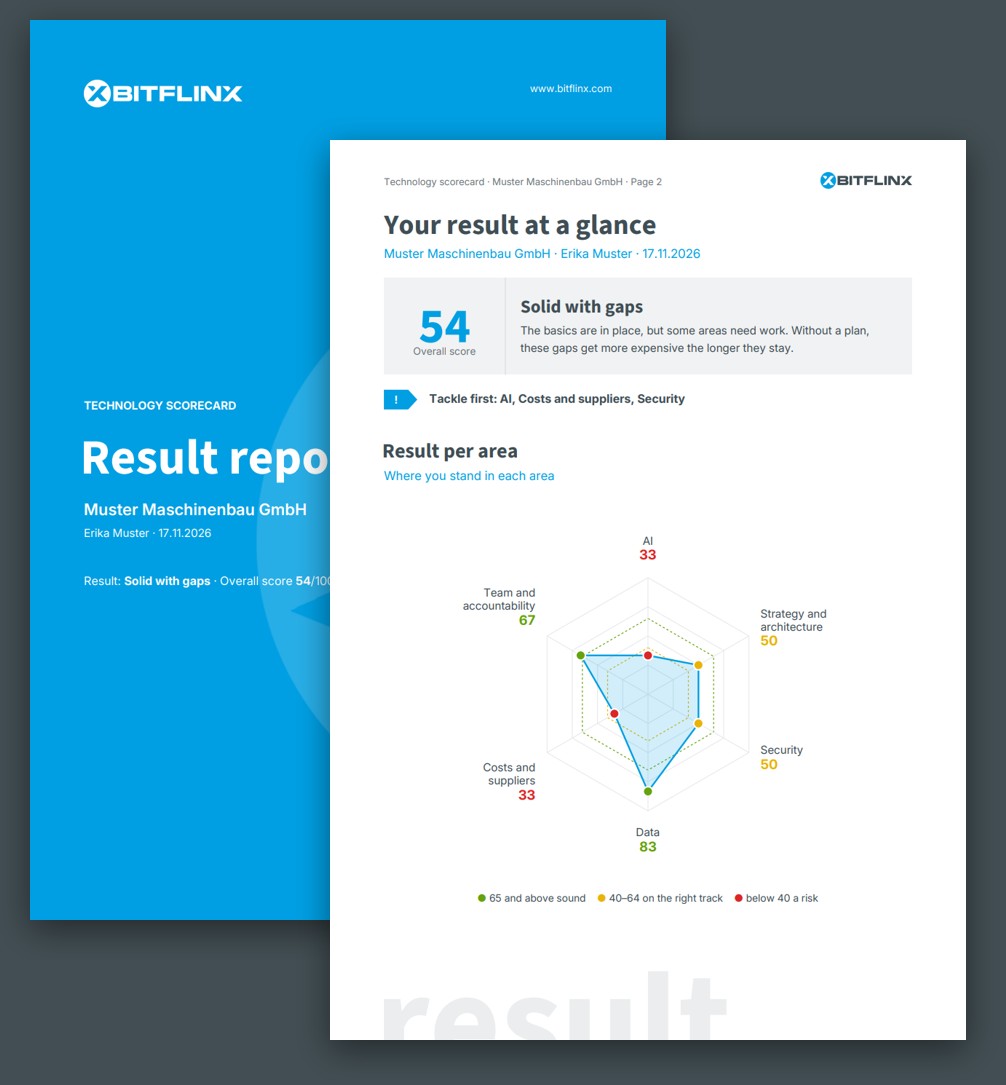
The Technology Traffic Light asks 15 questions about AI, strategy, security, data, costs and team. Ten minutes, instant result, free of charge.