IT leadership and role
How much does a fractional CTO cost?
Florian Rocktäschel · Last reviewed: November 2026 · 6 minute read
In short
A fractional CTO is usually billed by the day, either as a fixed number of days per month or per project. In Germany, companies pay around €1,300 per day on average for interim leadership. What it costs per month always depends on the situation: mainly on how many days it needs, not on the day rate alone.
How is a fractional CTO billed?
Four models are common, often combined:
- Day rate: each working day has a fixed price. This is the standard in interim management.
- Fixed days per month: for example four or eight days a month, which gives you a predictable monthly amount.
- Fixed price for an assessment: one to three weeks with a clearly defined result, such as a decision paper.
- Project in phases: for building a platform or a larger initiative, with more days during build phases.
Hourly rates exist but are rare for leadership roles. Someone who takes on accountability does not work in packages of hours.
What do companies pay on the market?
There is no independent survey that covers fractional CTOs alone. The best reference points are studies of interim management, that is, executives hired for a limited time. The figures below are for Germany:
| Source | Figure | What it means |
|---|---|---|
| DDIM market study 2025 | €1,297 per day (2025) | average across all functions in Germany |
| AIMP market study 2025/26 | €1,367 per day | price paid by the client, including the agency’s margin, excluding travel |
| Ludwig Heuse (2022) | IT projects €1,138 against an average of €1,102 | IT tends to sit slightly above average |
| freelancermap, 2025 | €120 per hour | freelance consulting and management, usually without leadership responsibility |
Figures published by individual fractional CTO providers vary far more widely. They are not collected independently and only give a rough idea.
What does that mean per month?
A worked example using the market average of around €1,300 per day:
| Scope | Days per month | Cost per month |
|---|---|---|
| quiet phase | 4 | about €5,200 |
| ongoing support | 8 | about €10,400 |
| build phase | 14 | about €18,200 |
| full-time interim | 20 | about €26,000 |
The comparison shows the point of the role: you only pay for the days your situation needs. Few in quiet phases, more during build phases.
What drives the cost?
- Experience and accountability: someone who has already been responsible for technology and for a company is usually above average.
- Scope: strategy only, or also building and running systems together with your team.
- Availability: fixed days, how reachable they are in between, who covers for them.
- Intermediaries: if you hire through an agency, you also pay its margin. The AIMP figures include it.
- Travel: usually charged on top and not included in the survey figures.
- Length of the engagement: longer engagements with many days a month are often offered at a lower rate.
How do you compare offers fairly?
Do not compare day rates in isolation, compare what you get for the money:
- How many days a month are fixed, and who can you reach in between?
- What will be on the table after the first few weeks, and how will you measure it?
- Does the provider earn from licences, hardware or commissions?
- Who owns the documentation, code and access credentials at the end?
- What notice periods apply, and how does a handover work?
A higher day rate can turn out cheaper if fewer days are needed, or if it prevents an expensive wrong decision with a supplier.
Why it always depends on the situation
A serious price can only be given once it is clear what the job is. A head of IT who leaves at short notice needs more days in the first weeks than ongoing support does. Building a platform needs more days during build phases than preparing for a customer audit. That is why many engagements start with a short assessment. Afterwards it is clear how many days a month are needed, and therefore what a month costs.
Frequently asked questions
It depends on the scope. Set the annual salary, including employer costs, onboarding and recruitment, against the days you actually need. With a few days a month the part-time solution is usually cheaper; with permanent full workload a full-time position is.
Usually, yes. The averages from the market studies do not include travel. Agree in advance how often someone needs to be on site.
For leadership roles, usually by the day. A day typically means eight hours.
That is a matter of negotiation. Monthly agreements with short notice periods are common, as are projects with fixed phases.
Sources
Last reviewed November 2026. The figures apply to interim management in Germany, not specifically to fractional CTOs.
- DDIM, Interim Management Report 2025 (German): ddim.de
- AIMP, interim management market study DACH 2025 (German): aimp.de (PDF)
- Summary of AIMP 2025/26 and Ludwig Heuse (German): interimmanagerportal.de
- freelancermap, Freelancer-Kompass 2025 (German): freelancermap.de (PDF)
About the author
I am Florian Rocktäschel, an engineer from RWTH Aachen. I have worked with machine learning since 2013 and as a fractional CTO for mid-sized companies since 2018. Here I write down what I am asked again and again in this work.
Where does your technology stand?
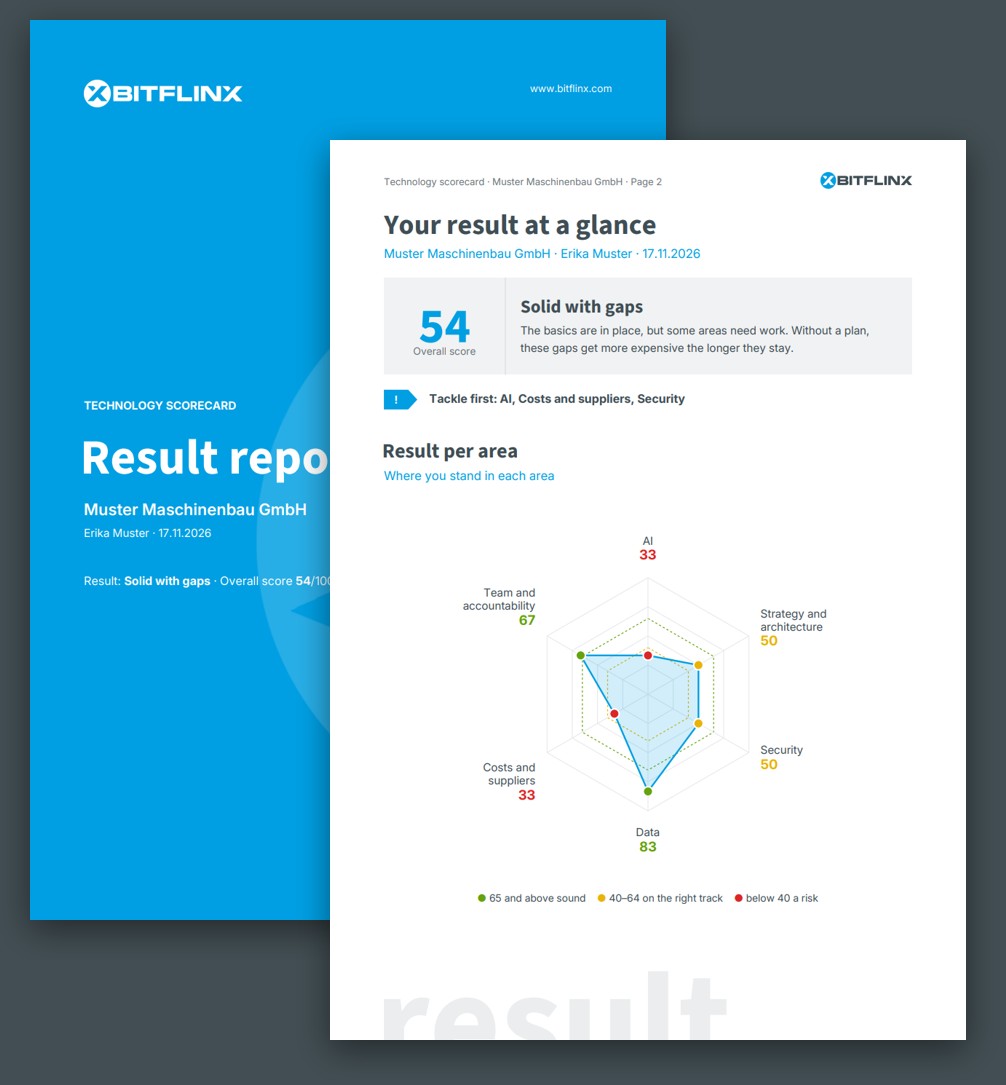
The Technology Traffic Light asks 15 questions about AI, strategy, security, data, costs and team. Ten minutes, instant result, free of charge.